Design Computation (DC) is an approach in architecture, engineering, and construction that leverages computation to generate building designs, manage the associated data, and evaluate design decisions [1]. DC differs to CAD-based design modelling, where the designer uses interactive geometry applications to manually create the finished building design. With this form of direct modelling there are no opportunities to record the rationale for the design and any subsequent design exploration requires further arduous manual edits. In Design Computation however, programs are written to generate the designs themselves as their output, explicitly programming the logic and method of its realisation, and enabling design intent to be more easily captured. The modification and re-execution of the program allows the designer to efficiently explore a larger solution space of alternatives or other forms of optimisation.
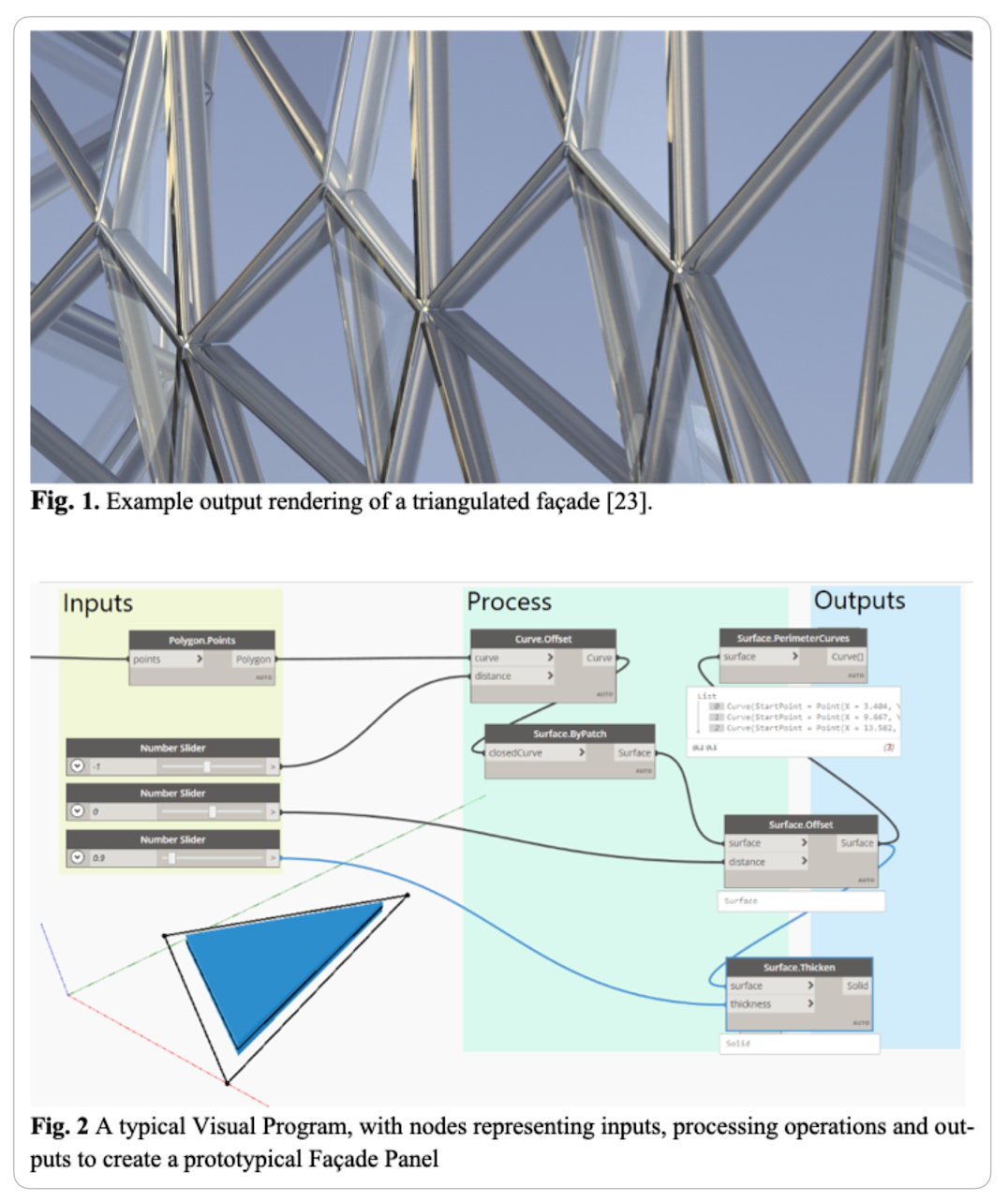
Facade rendering and a sample visual program for generating a component, taken from an early draft of [2].
At the heart of DC is programming, which must then be expressed in some programming language or languages. Both textual programming languages and visual programming languages are widely deployed in this space; some of these are general purpose and others are specialised, used only in these domains.
Following some long discussions with experts in industry (Al Fisher from Buro Happold) and academia (Prof Robert Aish, Bartlett School of Architecture, UCL) about how programming languages for design computation could be advanced, we put together a position paper on our ideas, published at Onward! 2024 [2].
Happily, our ongoing conversations have led to the generous support from Buro Happold for a 3.5 year PhD scholarship at the University of Kent to work with me on these ideas, collaborating with Al and others at Buro Happold.
This PhD project responds to the challenge: how can the unique ways of collaborative thinking and reasoning, which characterise the multi-disciplinary design of physical architecture and building engineering, be supported by new forms of programming languages, programming systems, and programming tools? This is an opportunity for some original language research; the potential exists for the ideas and methods developed in this specific domain to evolve into more general-purpose programming paradigms (following in the path of important historical precedents).
Funding is available for both international and home students, and includes travel funding. I have more details available here, and details of how to apply, along with the requirements for a candidate can be found here.
The deadline for applications is December 22nd 2026 with the aim of the candidate starting in April 2027. Please do share with any potential candidates who might be interested.
References
- Robert Aish and Nathalie Bredella. The evolution of architectural computing: from Building Modelling to Design Computation. Architectural Research Quarterly, 21(1), 65–73, 2017. doi:10.1017/S1359135517000185 ↩
- Robert Aish, Al Fisher, Dominic Orchard, Jay Torry. Programming languages for the future of design computation. In Proceedings of the 2024 ACM SIGPLAN International Symposium on New Ideas, New Paradigms, and Reflections on Programming and Software (Onward! 2024), 2024. doi:10.1145/3689492.3689812 ↩